ad-doctor
Read-only Active Directory security audit that fits in a pipeline.
ad-doctor binds as an ordinary domain user, takes one snapshot of the domain over LDAP (plus SYSVOL and a few cheap probes of every DC over SMB, LDAP, HTTP and the CA registry) and runs 99 checks for what attackers look for first: roastable accounts, risky delegation, exploitable certificate templates and CA settings (ESC1-9, 11, 13-17), DCSync and other takeover rights, shadow credentials, BadSuccessor, PrivExchange, exposed Entra Connect sync accounts, editable GPOs on domain controllers, local admin and remote logon rights handed out by Group Policy, passwords in Group Policy and scripts, relay-friendly DCs, weak trusts and legacy configuration. It then finds every control path from a non-admin to tier 0. It writes nothing to the directory.
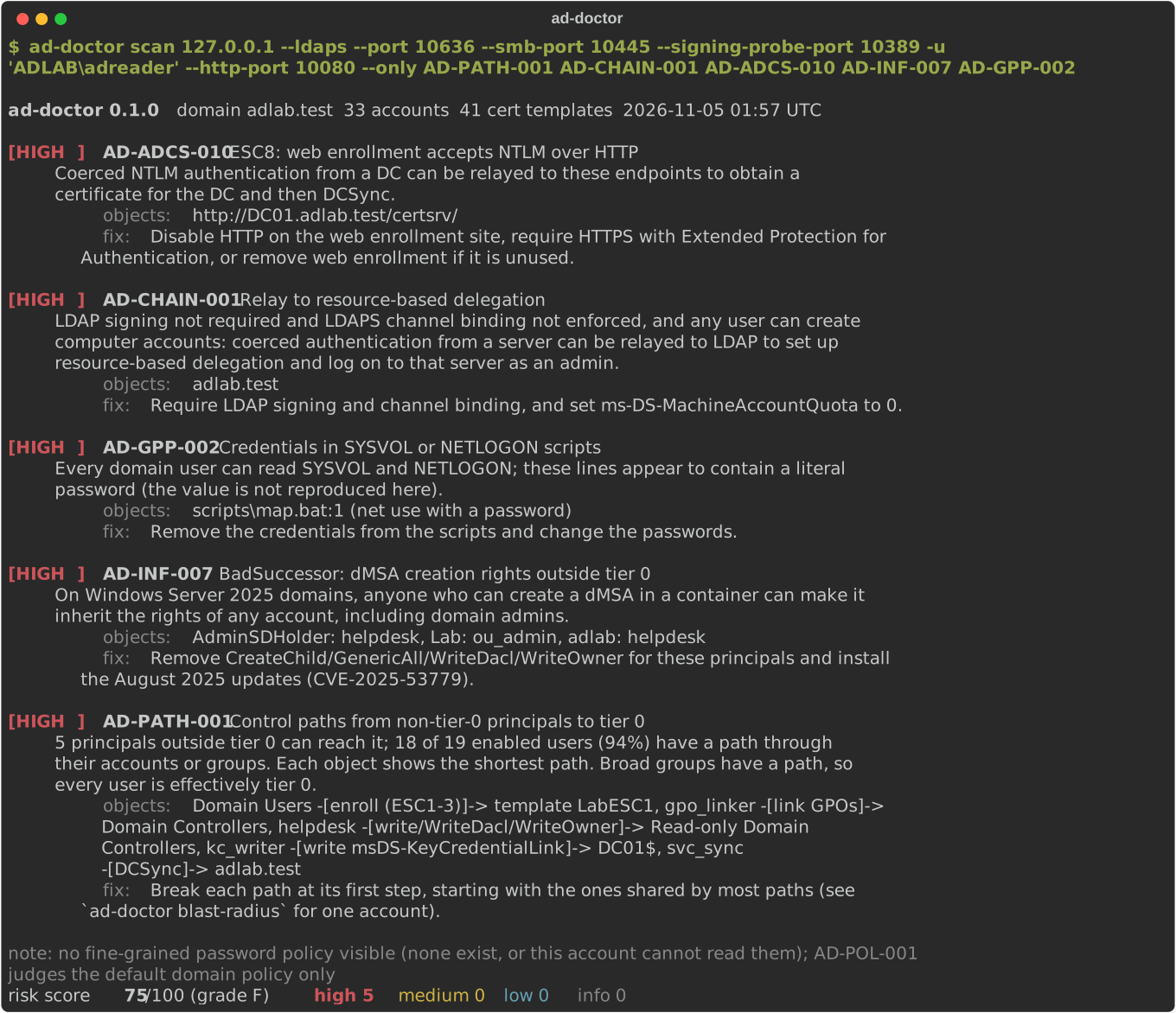
- Quick start: install and run your first scan.
- Check catalog: what each of the 99 checks and 5 invariants looks for and how to fix it.
- CI integration: SARIF, JUnit, baselines and accepted risks.
- Permissions needed: an enabled domain user, nothing more.
What sets it apart
- Attack paths without a graph database.
AD-PATH-001builds the control graph from the snapshot and reports the shortest path from every non-tier-0 principal to tier 0;ad-doctor blast-radiusanswers "what does this account control if it is phished?". - Plays well with BloodHound. The OpenGraph export keeps SIDs, so its edges attach to an existing SharpHound graph instead of building a second one. BloodHound offers Search and Cypher on it, not Pathfinding.
- Every DC, not just one. LDAP signing, SMB signing, the spooler and channel binding are probed on each domain controller, and findings name the ones that drift.
- Compound findings.
AD-CHAIN-*raise the alarm when individually medium findings add up to a known one-step compromise. - Built for CI. SARIF 2.1.0, JUnit, JSON with stable fingerprints,
--fail-onand--baselineso a scheduled job fails only on new findings. - Policy as code. An
invariants.tomldeclares the expected state; any drift becomes a finding. - Shareable snapshots.
redactpseudonymizes names, hosts and the domain SID with a keyed HMAC, so a snapshot can go to a consultant and still produce the same findings.
Tools like PingCastle and Purple Knight cover more ground overall and Locksmith goes deeper into AD CS; ad-doctor is the scriptable option, and the one that tests itself against a live DC.